Sarmisegetuza

Sarmisegetuza

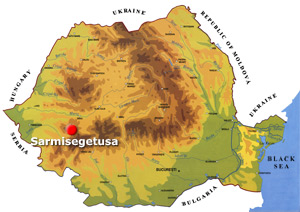
Romania Map - Sarmisegetuza

Sarmisegetusa Regia

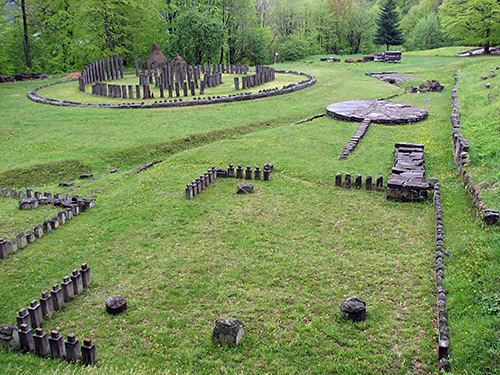
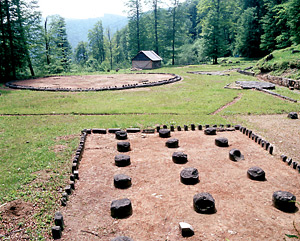
Sarmisegetuza Regia is the name of the capital of pre-Roman Dacia, actually a complex of sanctuaries, situated in The Mountains of Orastie, at an altitude of 1,200 meters, from which the most remarkable are “Sanctuarul Mare Rotund” (Big Rounded Sanctuary) and “Soarele de andezit” (The Andesito Sun). Most of the archeologists assert that the city was raised in between the 3rd and the 2nd century before Christ, while others sustain that it would be at least 600 years older than that. One of the reasons of this dispute could be the striking resemblance of the Big Rounded Sanctuary with those of Stonehenge. It seems that the same architect has conceived them both, the only difference being that the one from Orastie is smaller. Then, The Andesito Sun can be easily resembled to the famous Maya calendar.
Sarmizegetuza
Sarmisegetusa Sanctuary.

The capital of Dacia was conquered and destroyed by the Roman army in the year 106 after Christ. Its ruins were revealed for the first time in 1923 due to the diggings made under the lead of professor D. M. Teodorescu from the department of archeology of the University in Cluj Napoca, then continued by the academician professor C. Daicoviciu and by Hadrian Daicoviciu until 1944.
The road is not generous for those who want to get at the ruins of the ancient Dacian fortress. If there is asphalt laid from Orastie till Costesti, few are those who dare continue their trip by car following the next 20 km on forestry path. As a matter o fact Orastie can be considered a departure point for the Dacian fortresses; Sarmisegetuza Regia, The Fortress of Costesti (18 km away from Orastie), the Stone Walls of the Fortress from Blidaru (4km away from Orastie).
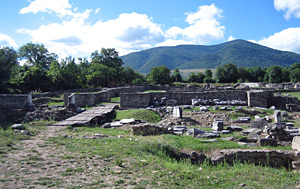
Sarmizegetuza
Sarmisegetuza.

At about 40 km away from Orastie Mountains, in the department of Sarmisegetuza, in the South- West of the Hateg Depression, where are the ruins of the other fortress bearing the same name, capital of Roman Dacia, also called Ulpia Traiana Sarmisegetuza, founded by the governor Terentius Scaurianus between 108 – 110.For two centuries, it represented the political and administrative center of the province of Dacia.
The sieges of the governor, of the administration, of the financial system, of the military, economic and religious centers were situated inside the fortress. During the rule of Emperor Hadrian (117-138), Sarmisegetuza was called Colonia Ulpia Traiana Sarmisegetuza, and then during the period 222-235, to its name was added the epithet of metropolis.

Sarmizegetuza - one name, two capitals
Sarmizegetuza.

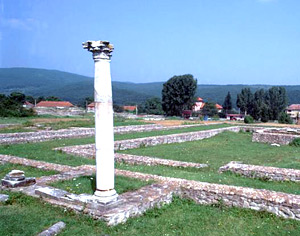
Ulpia Traiana Sarmisegetusa

In other words, the ruins of Ulpia Traiana Sarmisegetuza stand for the most interesting touristic attraction in the area, offering the tourists the image of a Roman city, resembling many others, with the Forum, palace of the augustals, the thermae, the amphitheatre, the public and private institutions. In 1982, there was inaugurated a museum where there are exposed objects in silver and bronze, ceramics, statues of the Roman gods, coin, funeral stones, medallions, mosaics and other objects.
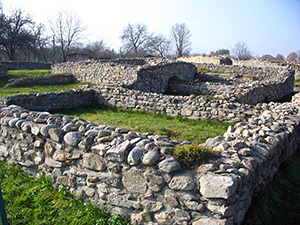
Sarmizegetuza
Ulpia Traiana Sarmisegetusa.

Other interest points in the area are represented by the Fortress of Colt, the Fortress of Malaiesti, the Densus Church, the Church from Strei and also the Fortress of Hateg. Tourists cand get here using the national road DN 68 Hateg-Caransebes, or by train, following the route Petrosani-Subcetate or Simeria-Subcetate. Also, the possibilities of accommodation are multiple due to the touristic boarding houses and to the special places for pitching the tent in the area surrounding the colony.
Beside the Roman fortress, tourists can also visit Sarmisegetuza, the caves Cioclovina, Ohaba Ponor, the Monastery of Prislop and the “Fortress of Colt” in the village of Suseni.
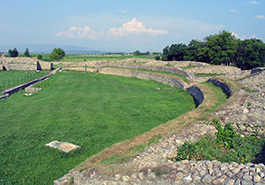
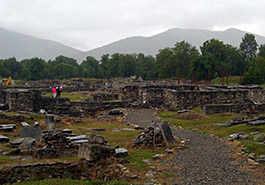
Sarmisegetuza
The Amphitheatre – Ulpia Traiana Sarmisegetusa.
Sarmisegetuza
Ulpia Traiana Sarmisegetusa.

Bucovina Travel Guide

2 Responses to “Sarmisegetuza”

  1. My hunch is the Buryans of Siberia, later called Hyperboreans, Bulgarians, and the Anatolian “Van” kingdoms to be the migrants who brought the “henge” sanctuary to Dacia. The Mayan Calendar – written by a blond-hair and blue-eyed person – to be the same highly accurate Bulgarian calendar (recognized by UNESCO) given to the Mayans. The pillars/poles of Stonehenge number 56, a Hyperborean number for the “Year of Menton” relative to Earths axial polar tip and its nutation cycle of 18.6 years. I believe the Germanic Buri tribe affialiate of the Dacians, who claim their name mimics the 1st Nordic god Buri, to also be of Hyperborean origin. In Iranian mythology al-Burjan (Georgia) would also be the same Buryans of Siberian ancestors.

    Thus my last name are of these same people. Note the city or village Burjanfalva (now Paulis) in Romanian/Transylvanian history.

    My great-grandfather came to USA in 1882 from Prague, as Bohemian. This Dacian region is a stepping-stone migration pathway therein. This is also the “wolf-warrior” clans which I think you’ll find agreeable with the Dacians and your reference to Zeus and Apollo, who was actually “wolf’ Zeus on Wolf Mountain in Greece. These Hyperboreans were also called Palasgians, but are actually Hyperboreans, ie. who called themselves Vans. The Veneti (of Liburnia) and from Lake Van were of the same ancestors. The Veneti language is indentified and linkable as such. The aboriginal people by Lake Van were Subarians, which i read as Su-Barians, ie. Buryans. Any comments?

    Also, I would suggest looking at the newer “Borean” language hypothesis published in the year 2000 (Russian) made available recently in web based Wikipedia. This newer theory I believe to be correct, and it may cure your questions as to Altaic and/or Indo-European (IE) language theories.

    Note that Buddah’s original name from Iran (he was a blond-hair and blue-eyed Sakastan prince, or a Saka (Scythian), before going to India, and his name (I think as quasi-Persian was Bury/xan. This y/x is a Persian hybrid character I can’ t reproduce as English. Anyway, he was a Buryan. Thus, some of these factors – I think – are solvable. Note that Saka coins of (Iran) exhibit “Zeus” – as commented about on your web page – pertaining to anybody wondering about Asian or Indo-European inputs.

    There is also fort Gust-i Burjan in Iran from 200-100 B.C.
    I tested my DNA and have these markers, ie. Siberia, India (Hindi), Iran, etc., and I also have this as a surname, thus I can substantiate these factors – I believe.

    All domesticated dogs from DNA studies exhibit the Siberian “wolf” DNA ancestors. Buryans of Siberia is the origin of “wolf-warriors”, and also, all domesticated dogs too. Dacians were of this bloodline, or an affiliate or confederated version of tribes from this “Tamga” or symbolic tribal descent. A date for this Wolf-Dog event would be ~20-30,000 BC in Siberia, as the Amercan Indians migrated from Siberia at about this period, and they brought the dog with them. Thus, this pre-dates “all” wolf parables, unless someone would like to “add” perhaps an earilier version, which I don’t expect to here about soon. National Geographic released a film pertaining to these dog-DNA-Siberian studies for the skeptics who read this.

    Also, my Siberia-Afro DNA can also be matched to to Grimaldi-Venus artifacts dug up in Malta and Buret, located within ~ 80 km of Lake Baikal, home of Buryats, also from Ice Age – Buryans.

    Both Central Asia, and India are merely stepping-stones to this common migration westward during the earliest epic of Modern Humans, who arrived in Siberian regions at 22,000-25,000 B.C. – the age of these Afro-Siberian artifacts – and my Afro-Siberia DNA that I’ve already tested. The word Siberia – I think – is Si-Beria, which is Buryans too. I think you’ll find my inputs ring true.

    Can anyone confirm or provide a second definition from my studies of Dacians?

    Thanks for your web data. Also, I would like to receive credit for my inputs and use of my name as Authorship for perhaps “newer’” concepts would be appreciated. I’m also willing to receive e-mail from interested parties for comment.

    I’ve been writing a quasi-book on my studies of my surname since 1973, and hope to get a published (1st Edition) version by the end of this year, as I have quite a bit of research pertaining to this name, and its ancient, and global relevance, I’m totally amazed at the path I’ve ended up on once enough factors were obtained to start to make sense out some sort of evolution therefrom, which is how my research is directed. I have “many” versions of this name.

    Also, the Dacian – Burebista (Greek) name I think might originate as Buri, or of the Buri tribe. Any comments?

    Also, Dacian Burzenland I believe to be Goth-Buryans too.
    There is an eastern version as Buryzan which to me becomes obvious. Bashkirs/Bashkorts of Central-Asia are Buryan “wolf-warriors” too. Ref; Baskhortostan Russia.

    Comment welcome. PS, I hope I haven’t overwhelmed responders for these comments, realizing Dacia is a very difficult region to pick-apart, but I do believe “this can be done’” – at least eventually. I believe I’m on the right path, and this is a rather new and different approach perhaps at disecting the Dacian relationships, and the ruins and artifacts found in Dacia today which can be yet further extrapolated and rationallized

  2. I want to correct my comment previously concerning the Hyperborean “Year of Menton”. This is a conjunction time period where both Solar and Lunar cyclic periods align every ~18.6 years, to a given Earth seasonal period cyclic point (in time). The other Earth axial wobble cycle is ~30,000 years and relative to the Mayan calendar year 2012, coming up shortly.

    I will also note that the Hyperborean (Greek for extreem-north) god Boreas (who exhibits wings) would visit his homeland in the north during the Year of Menton, by flying North (in also winged chariots) to get there. Zeus and Apollo Greek gods are also believed to be of Hyperborean (Palasgian) origins.

    Hyperborea and Atlantis haven’t been located, so these factors remain in the realm of mythical characters from mythology.

    Also, the Mayan calendar may or may not be related to Hyperboreans, who may be Bulgarians, and thus a relationship to the Bulgarian “highly accurate” calendar and the Bulgarian present day location by Romania. The Mayan calendar is also unusually accurate, and exhibits great depth in concept for astronomy suggesting this possible relationship.

    I believe the “Year of Menton” is a soley Hyperborean concept inter-related to England’s Stonehenge layout (circular distribution and number of post hole points) and the number 56. (ref; Solving Stonehenge, Anthony Johnson, published by Thames and Hudson 2008).

    I hope this will clarify my own mistake in previous comments herein.

Leave a Reply