Travel Guide – Bucovina
The Bucovina Travel Guide is sold out. We are considering the preparation of a second edition. In case you are interested in the book, please send us an email to metaneira@metaneira.com and we will keep you posted.
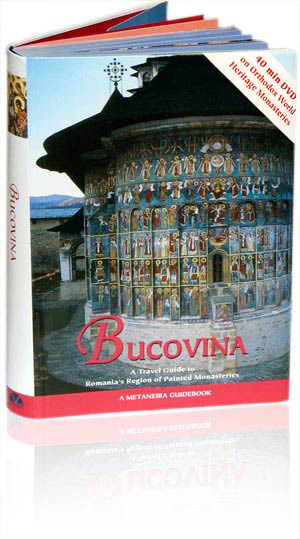
512 pages
784 photographs
387 colour and black and white drawings
10 aquarelles
Price 29.99 € including a 40-min DVD
Inside Bucovina Guide
Buy Bucovina Guide
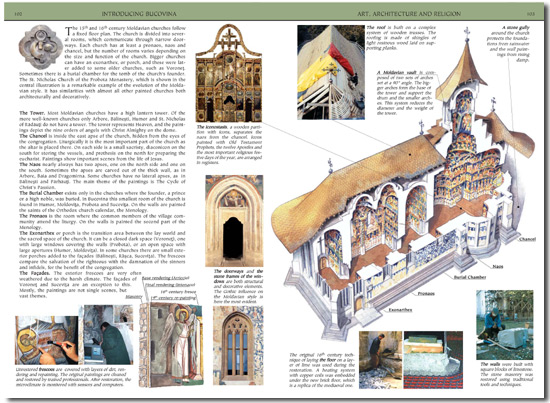
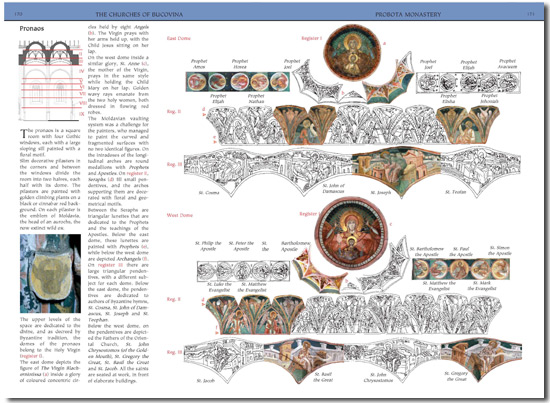
Bucovina – A Travel Guide to Romania’s Region of Painted Monasteries is a travellers’ guidebook, presenting the beautiful monasteries and churches of Bucovina. These churches are unique in the world for their fully frescoed exterior and interior walls. The feature, which will make this guide to stand out from the others, is the inclusion of line drawings of these frescoes. These “maps” of the mural paintings show the scenes depicted on the walls, subjects identified, and outlines sketched in ink. Usually travellers can only admire the scenes, but cannot interpret their meaning. Besides the monasteries, the guidebook outlines in great detail the traditional way of life of the region, the history of Moldavia and Romania , and the traits of art, architecture and religion in this area. Further, there is practical travel information on where to go, what to see, how to get there, and a short vocabulary of the Romanian language.
Buy Bucovina Guide
The guidebook is unique in its kind as there is nothing available in the market that tells you, in a way that is precise and scientifically correct, what the paintings show nor what they meant when they were created. Moreover, information that explains how certain scenes came into the iconographic canon and why, and how they were related to the local folklore and contemporary 16th and 17th century life is available only in scientific essays that are not available for the large public.
As in the case of all our books, the language chosen for the guidebook is English. Further, the guide includes a 40-minute DVD with scenes showing the life in the Bucovina monasteries and villages. The DVD comes with the guidebook, without any additional cost.
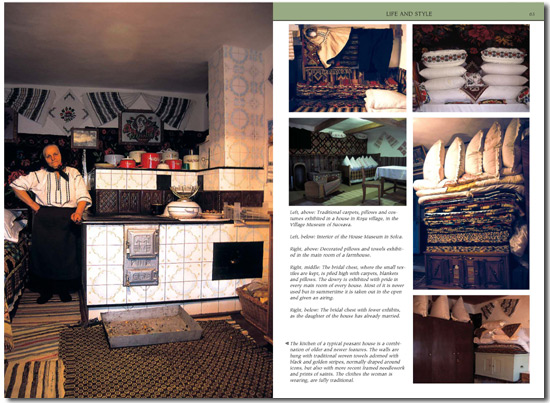
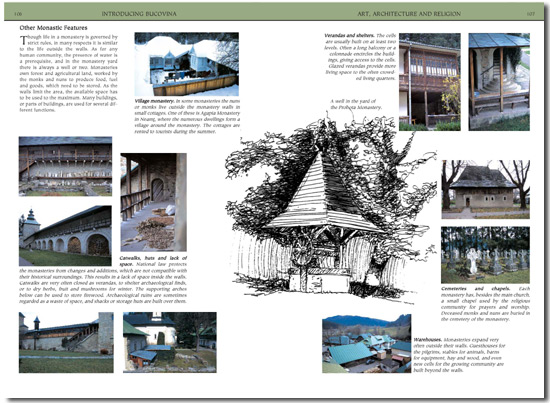
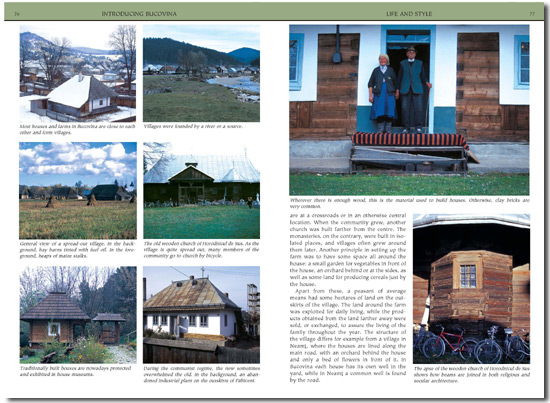
The first part of the book is divided into four chapters: Geography, History, Life and Style, and Art, Architecture and Religion. Here are found extensive texts on the background and history of Moldavia and Bucovina, in relation to both Romania and Europe. These chapters describe the phenomenon of the painted churches, why they were created, and what was the historical context. But not only history and monuments are handled here, but the everyday life and customs of the people of Bucovina is explained and illustrated with photographs and drawings.
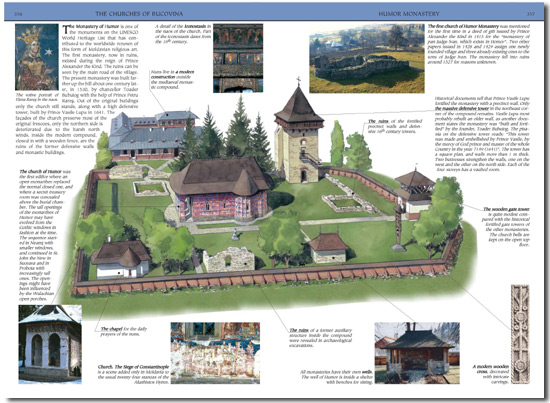
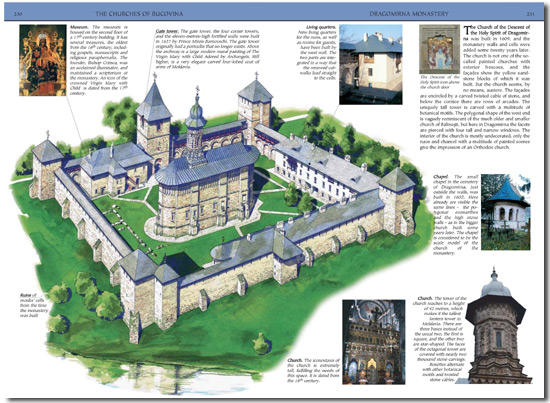
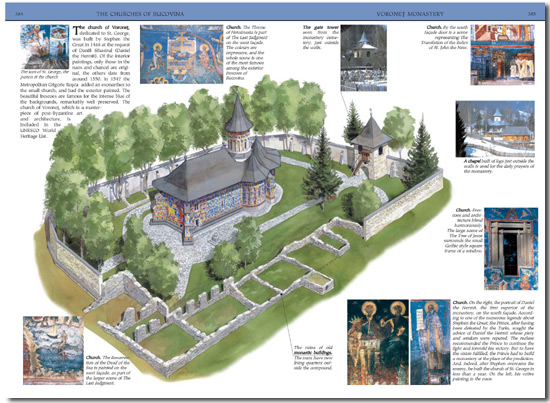
The second part of the book describes 18 of the most significant monasteries and churches of Bucovina, and six others in nearby Neamţ County. For each monastery there is an explanatory text, along with photographs of the church, the compound and the wall paintings, and for the most important ones there are also detailed three-dimensional illustrations and cutaways. A unique feature is the line drawings, made especially for this book, of the interior and exterior frescoes of the most representative churches. These line drawings are detailed and full of information, and will help the reader to identify scenes, which are painted high up on the walls, or may be difficult to locate among the profusion of frescoes.
The last part of the book gives practical information and tips on travel to and in Romania. Here are chapters on what to see, where to stay, what to buy and to eat, to get the most of Bucovina. The hotels and pensions that are most conveniently located to tour the monasteries are described. Other types of accommodation available in the area are described, such as cottages, farmhouses and camping sites. To help tourists and travellers, there are maps of the surroundings of the larger towns with local attractions and sites to see marked on them.
Altogether there are 784 full-colour photographs in the guidebook. In addition there are 347 colour and black and white drawings, as well as ten aquarelles made especially for this book, to render it more useful for the traveller. There are special openings on the different architectural features of the monuments, windows, doors, towers, and monastic buildings, illustrated with examples of stylistic differences and drawings. Further, there are openings with drawings on such subjects as Prehistoric Moldavia, The Dacians and the Romans, Stephen the Great, Petru Rareş and the Painted Churches, Moldavia and a United Romania, Soba – the Heart of the House, The Traditional Farmyard in Bucovina, and Sheepfolds of Bucovina.
We accept payments through PayPal. PayPal makes buying products and services or even sending money as easy as sending emails. It is the leading online payment system in the world. Fast, Easy and Secure!
You don’t need a PayPal account. Pay securely using your credit card.
If you don’t have a credit card and want to order the book, please contact us at order@romanianmonasteries.org.
We will try to find a different way to send you this beautiful book.
Price 29.99 € + shipping and handling, including a 40-min DVD about Bucovina.
For purchases made in US dollars or other currencies they will be converted automatically in euros.
Questions about the order process? Please do not hesitate to contact us:
Tel: + 40-753-608318
 Travel Bucovina
 Travel Maramures
 Travel Romania
 Other Monasteries from Romania
“We returned from our two-week stay in Maramures and Bucovina two days ago. I wish to once more thank you for your guides; they proved to be an invaluable help in understanding the paintings in Maramures churches and Bucovina monasteries, but also a way to communicate with local people.
Sometimes in Maramures, when we could not find a church and showed its photos in your book to local people, they would take the guidebook, leaf through it, and with great excitement discover their friends and neighbors, and even themselves on the photographs… This opened quite a few doors to us – in the literal sense, doors to locked bisericas, but also to the world of the village people. Once we even got invited to a local wedding!”
Barbara Gadomska
“I have in my hands your precious guide book about the incredible heritage, most particularly Bucovina area, has to offer. But, as an art history lover myself, and someone that has already written two books – just one published, I’m afraid – I think the book does not only does honour to all those about whom you speak, but most of all to the glorious and prestigious art and history heritage it deals with. Nevertheless, this guide book has been one of the most brilliant achievements I have ever seen, only comparable to the French Gallimard series, but much better as it dwells in a world very much of its own.
I tell you this because I’d like to congratulate you on the excellent job very well done. I think thanks you as well. But this compliment is not devoid of emotion, as I, myself, have been trying to publish, in, something of the kind, about my own country’s heritage and art cities, up until now with no success whatsoever. So, when I say your guide is positively the best of its kind I have seen until now, believe me, I know it for sure. Congratulations!!
It is, without a shadow of a doubt, the best thing that has been recently published.”
Carlos de Oliveira